
Economy MCQ Quiz - Objective Question with Answer for Economy - Download Free PDF
Last updated on May 29, 2026
Latest Economy MCQ Objective Questions
Economy Question 1:
A change in the hereditary characteristics of a species over successive generations is known as ________.
Answer (Detailed Solution Below)
Evolution


Economy Question 1 Detailed Solution
- A change in the hereditary characteristics of a species over successive generations is known as evolution.
- A branch of biology which is concerned with the study of heredity, genes, and genetic variation is known as genetics.
- Ecology is the study of interactions of organisms with their environment.
- A process by which a new organism or offspring is produced by parents is known as reproduction.


Economy Question 2:
Consider the following statements about Multidimensional Poverty Index (MPI) :
1. MPI is calculated using Alkire-Foster methodology.
2. MPI calculated by NITI Aayog has a total of twelve indicators.
3. Maternal Health and Bank Account are common indicators in the MPI of NITI Aayog and MPI of United Nations Development Programme (UNDP).
Which of the statements given above is/are correct ?
Answer (Detailed Solution Below)
Economy Question 2 Detailed Solution
The correct answer is 1 and 2 only
 Key Points
- Statement 1 is correct: The Multidimensional Poverty Index (MPI) is calculated using the Alkire-Foster (AF) methodology. Developed by Sabina Alkire and James Foster, this mathematical framework identifies the poor by considering the overlapping deprivations they face in multiple areas of life simultaneously.
- Statement 2 is correct: The National MPI, designed and released by NITI Aayog, includes a total of twelve indicators. These indicators are distributed across three dimensions: Health, Education, and Standard of Living.
- Statement 3 is incorrect: Maternal Health and Bank Account are not common indicators. While the global MPI (released by UNDP and OPHI) consists of 10 indicators, NITI Aayog added two specific indicators to the Indian version to better align with national priorities. These two indicators are Maternal Health (added under the Health dimension) and Bank Account (added under the Standard of Living dimension).
 Additional Information
- The Global MPI was first launched in 2010 by the United Nations Development Programme (UNDP) and the Oxford Poverty and Human Development Initiative (OPHI).
- The three dimensions of the index—Health, Education, and Standard of Living—each carry an equal weightage of 1/3.
- The twelve indicators used in India's National MPI are: Nutrition, Child & Adolescent Mortality, Maternal Health, Years of Schooling, School Attendance, Cooking Fuel, Sanitation, Drinking Water, Electricity, Housing, Assets, and Bank Account.
- NITI Aayog serves as the nodal agency for the Multidimensional Poverty Index in India, and it coordinates with the Multidimensional Poverty Index Coordination Committee (MPICC).
- The primary data source for the National MPI in India is the National Family Health Survey (NFHS).
Economy Question 3:
Consider the following statements about the Non-Banking Financial Companies (NBFCs) in India :
1. NBFCs cannot accept demand deposits.
2. All the NBFCs operating in India have to be registered with the RBI.
3. NBFCs form part of the payment and settlement system and can issue cheque drawn on itself.
4. Deposit insurance facility of Deposit Insurance and Credit Guarantee Corporation (DICGC) is not available to the depositors of deposit taking NBFCs.
Which of the statements given above is/are correct ?
Answer (Detailed Solution Below)
Economy Question 3 Detailed Solution
The correct answer is 1 and 4
Key Points- Statement 1 is correct: A Non-Banking Financial Company (NBFC) is a company registered under the Companies Act, 1956 (or 2013). One of the primary differences between a bank and an NBFC is that NBFCs cannot accept demand deposits (like savings or current account deposits that can be withdrawn at any time). They can only accept term deposits or public deposits for a minimum period of 12 months.
- Statement 2 is incorrect: Not all NBFCs are registered with the Reserve Bank of India (RBI). To avoid dual regulation, certain categories of NBFCs are regulated by other financial regulators. For example, Housing Finance Companies are regulated by the National Housing Bank (NHB), Insurance Companies by IRDAI, and Stock Broking Companies by SEBI. These are exempted from registration with the RBI.
- Statement 3 is incorrect: NBFCs do not form part of the Payment and Settlement System. Therefore, they cannot issue cheques drawn on themselves, whereas banks are an integral part of this system.
- Statement 4 is correct: The deposit insurance facility provided by the Deposit Insurance and Credit Guarantee Corporation (DICGC), which covers up to 5 lakh rupees for bank depositors, is not available to the depositors of NBFCs. Depositors in NBFCs carry a higher risk as their money is not protected by this guarantee.
Additional Information- An NBFC is defined as an institution whose principal business is receiving deposits under any scheme or arrangement or lending in any manner. However, it does not include institutions whose principal business is agricultural activity, industrial activity, or the purchase and sale of goods.
- NBFCs are classified based on their liabilities into Deposit-taking NBFCs (NBFC-D) and Non-Deposit-taking NBFCs (NBFC-ND).
- In recent years, the RBI has introduced a scale-based regulatory (SBR) framework for NBFCs, dividing them into four layers: Base Layer, Middle Layer, Upper Layer, and a possible Top Layer, depending on their size, risk, and activity.
- The Companies Act and the RBI Act, 1934 provide the legal framework for the functioning and supervision of NBFCs in India.
Economy Question 4:
With reference to different Committees in India, consider the following details :
| Sl. No. | Committee | Objective | Organization under which it was formed |
|---|---|---|---|
| 1. | R.N. Malhotra Committee | Comprehensive reforms of Insurance sector in India | Insurance Regulatory and Development Authority of India |
| 2. | L.C. Gupta Committee | Preparing a roadmap for the introduction of derivatives trading in India | Securities and Exchange Board of India |
| 3. | Urjit R. Patel Committee | Preparing a roadmap for reforming bank lending to the Housing sector | Reserve Bank of India |
| 4. | Y.H. Malegam Committee | Preparing a roadmap for reforms in Microfinance sector in India | Reserve Bank of India |
In which of the above rows are all the details correctly matched ?
Answer (Detailed Solution Below)
Economy Question 4 Detailed Solution
The correct answer is 2 and 4
Key Points- L.C. Gupta Committee (1996): This committee was appointed by the Securities and Exchange Board of India (SEBI). Its primary objective was to develop a regulatory framework for the introduction of derivatives trading in India. The committee recommended the phased introduction of financial derivatives, starting with stock index futures. Hence, row 2 is correctly matched.
- Y.H. Malegam Committee (2010): The Reserve Bank of India (RBI) constituted this committee to study the issues and concerns in the Microfinance sector (specifically NBFCs operating in the MFI space). It was formed following the microfinance crisis in Andhra Pradesh. Its recommendations led to the creation of a new category of non-banking finance companies called NBFC-MFIs. Hence, row 4 is correctly matched.
- R.N. Malhotra Committee (1993): Although this committee was responsible for proposing comprehensive reforms for the Insurance sector, it was set up by the Government of India, not by the IRDAI. In fact, the Insurance Regulatory and Development Authority of India (IRDAI) was established in 1999 as a direct result of this committee's recommendations. Hence, row 1 is incorrectly matched due to the organization.
- Urjit R. Patel Committee (2014): This committee was appointed by the RBI to review and strengthen the Monetary Policy Framework in India. It recommended the shift towards inflation targeting based on the Consumer Price Index (CPI). It did not focus on reforming bank lending to the Housing sector. Hence, row 3 is incorrectly matched.
Additional Information- Narasimham Committee (1991 and 1998): These committees are foundational for Banking Sector Reforms in India, suggesting measures like reduction in SLR and CRR.
- Tarapore Committee: Appointed by the RBI to provide a roadmap for Capital Account Convertibility in India.
- Nachiket Mor Committee: Focuses on Comprehensive Financial Services for Small Businesses and Low-Income Households, leading to the conceptualization of Payments Banks.
- Shiva Raman Committee: Its recommendations led to the establishment of the National Bank for Agriculture and Rural Development (NABARD) in 1982.
Economy Question 5:
Which of the following statements about insurance in aviation sector is/are correct ?
1. 'Aviation Hull Insurance' covers the physical aircraft, including the body, engine, and on-board equipment.
2. Under the Montreal Convention, adopted in 1999 by over 130 countries, including India, airlines are strictly liable to pay compensation to the family/nominee of every deceased passenger without requiring the family to prove fault.
Select the answer using the code given below :
Answer (Detailed Solution Below)
Economy Question 5 Detailed Solution
The correct answer is Both 1 and 2
Key Points- Aviation Hull Insurance is a specialized insurance policy that provides coverage for physical damage to the aircraft itself. This includes the fuselage, engines, machinery, and all on-board equipment. It protects the owner or operator against financial loss from accidental damage or total loss of the aircraft while in flight, taxiing, or on the ground. Therefore, statement 1 is correct.
- The Montreal Convention (1999), officially known as the Convention for the Unification of Certain Rules for International Carriage by Air, was designed to establish a uniform legal framework for international air carriage. India is one of the 130+ countries that have adopted this convention.
- Under this convention, a two-tier liability system was established. For the first tier, airlines are strictly liable for damages up to a certain limit in case of passenger death or bodily injury. This means the family or nominee of the deceased does not need to prove that the airline was at fault or negligent to receive compensation. Therefore, statement 2 is correct.
Additional Information- Liability Limits: Compensation under the Montreal Convention is calculated in Special Drawing Rights (SDR), which is a reserve asset created by the International Monetary Fund (IMF). The strict liability limit is periodically adjusted for inflation by the International Civil Aviation Organization (ICAO).
- India's Implementation: The Indian government implemented the provisions of the Montreal Convention through the Carriage by Air (Amendment) Act, 2009, ensuring that Indian passengers on international flights benefit from these global standards.
- Hull War Insurance: This is a separate type of coverage from standard hull insurance that specifically covers risks like war, terrorism, hijacking, and civil unrest, which are typically excluded from general hull policies.
- Passenger Liability Insurance: This is mandatory for most commercial airlines and covers legal liability for injury or death of passengers, as well as damage to baggage and delays.
Top Economy MCQ Objective Questions
'Golden Revolution' is related to ________.
Answer (Detailed Solution Below)
Economy Question 6 Detailed Solution
Download Solution PDFThe correct answer is Horticulture and Honey.
Key Points
- The Golden Revolution is related to Horticulture and Honey.
- It started in 1991 and lasted till 2003.
- Father of Golden Revolution: Nirpakh Tutaj.
- The Golden Fibre Revolution is related to Jute Production.
Additional Information
| Revolution | Relation |
| Brown Revolution | Leather, Cocoa |
| Green Revolution | Agriculture Production |
| Grey Revolution | Fertilizers |
| Pink Revolution | Onions, Prawn |
| Red Revolution | Meat, Tomato Production |
| Round Revolution | Potato Production |
| Silver Fibre Revolution | Cotton Production |
| Silver Revolution | Egg Production |
| White Revolution | Dairy, Milk Production |
| Yellow Revolution | Oil Seed Production |
| Blue Revolution | Fish Production |
| Black Revolution | Petroleum Production |
The concept of five-year plans in the Constitution of India is borrowed from _______.
Answer (Detailed Solution Below)
Economy Question 7 Detailed Solution
Download Solution PDFThe correct answer is Russia.
Key Points
- The constitution of India has borrowed most of its provisions from the constitution of different countries in the world.
- According to Dr B R Ambedkar, the constitution of India has been framed after ransacking all the known constitutions of the world.
- The important provisions borrowed from Russia are:
- Five-year plan.
- Fundamental duties.
Additional Information
- The important provisions borrowed from Britain are:
- Parliamentary form of government
- Rule of Law.
- Single Citizenship.
- Office of Comptroller and Auditor General of India.
- Bicameralism.
- Writs.
- The important provisions borrowed from the United States are:
- Fundamental rights.
- Preamble.
- Independence of judiciary.
- Judicial review.
- Impeachment.
- Post of vice-president.
- The important provisions borrowed from Germany:
- Suspension of Fundamental Rights during the emergency.
During which five year plan did India opt for a mixed economy?
Answer (Detailed Solution Below)
Economy Question 8 Detailed Solution
Download Solution PDFThe correct answer is Second Five Year Plan.
Key Points
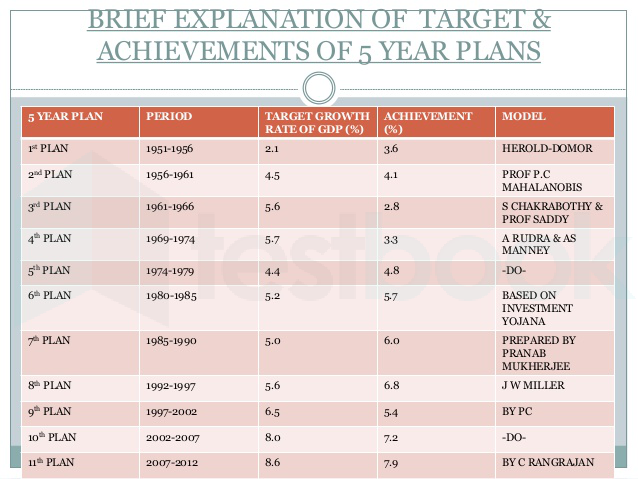
- Second Five-year plan (1956 to 1961)
- The second plan was conceived in an atmosphere of economic stability.
- It was felt agriculture could be accorded lower priority.
- Industries got more importance in the 2nd five-year plan. The focus was mainly on heavy industries.
- The Indian government boosted the manufacturing of industrial goods in the country.
- This was done primarily to develop the public sector.
- The Plan Focussed on rapid industrialization- heavy & basic industries.
- Advocated huge imports through foreign loans.
- Therefore, the Indian Government adopted a mixed economy during the second five-year plan. Hence, Option 2 is correct.
- The Industrial Policy 1956 was based on the establishment of a socialistic pattern of society as the goal of economic policy.
- Acute shortage of forex led to pruning of development targets, the price rise was also seen ( about 30%) vis a vis decline in the earlier Plan & the 2nd FYP was only moderately successful.
 Important Points
- The 2nd year five-year plan functioned based on the Mahalanobis model.
- The Mahalanobis model was propounded by the famous Prasanta Chandra Mahalanobis in the year 1953.
- As many as five steel plants including the ones in Durgapur, Rourkela ,Bhilai were set up as per the 2nd five-year plan.
- During the term of the 2nd five-year plan, Atomic Energy Commission came into being.
- The Commission was established in the year 1957.
- During the same period, the Tata Institute of Fundamental Research was born.
Additional Information
- First Five Year Plan:
- It was launched from 1951 to 1956, under the leadership of Jawaharlal Nehru.
- It was based on the Harrod-Domar model with a few modifications.
- Its main focus was on the agricultural development of the country.
- This plan was successful and achieved a growth rate of 3.6% (more than its target of 2.1%).
- At the end of this plan, five IITs were set up in the country.
- Third Five Year Plan:
- It was made from 1961 to 1966.
- It is also called ‘Gadgil Yojna’, after the Deputy Chairman of Planning Commission D.R. Gadgil.
- The target of this plan was to make the economy independent.
- The stress was laid on agriculture and the improvement in the production of wheat.
- India was engaged in two wars: (1) the Sino-India war of 1962 and (2) the Indo-Pakistani war of 1965. These wars exposed the weakness in our economy and shifted the focus to the defense industry, the Indian Army, and the stabilization of the price (India witnessed inflation).
- The plan was a flop due to wars and drought. The target growth was 5.6% while the achieved growth was 2.4%.
- Fourth Five Year Plan:
- Its duration was from 1969 to 1974, under the leadership of Indira Gandhi.
- The two main objectives of this plan i.e. growth with stability and progressive achievement of self-reliance.
- Fourteen major Indian banks were nationalized.
- Indo-Pakistani War of 1971 and the Bangladesh Liberation War took place.
- Implementation of Family Planning Programmes was amongst major targets of the Plan
- It failed and could achieve a growth rate of 3.3% only against the target of 5.7%.
Dairy comes under which sector of economic activity?
Answer (Detailed Solution Below)
Economy Question 9 Detailed Solution
Download Solution PDFThe correct answer is Primary sector.
Key Points:
- Activities that generate income are termed as economic activities.
- On the basis of economic activities, the Indian economy can be divided into 3 major sectors that are the primary sector, the secondary sector, and the tertiary sector.
- Dairy comes under the primary sector.
- Primary sector: Primary activities are directly dependent on the environment as these refer to the utilization of the earth’s resources. It, thus includes hunting and gathering, pastoral activities, fishing, apiculture, etc.
- Secondary sector: Secondary activities add value to natural resources by transforming raw materials into valuable products. Therefore, they are concerned with manufacturing, processing and construction industries. For eg: Shoe factory.
- Tertiary sector: Tertiary activities include both production and exchange. The production involves the ‘provision’ of services that are consumed. The exchange involves trade, transport and communication facilities that are used to overcome distance. For eg: Consultancy.
When was the Planning Commission set up?
Answer (Detailed Solution Below)
Economy Question 10 Detailed Solution
Download Solution PDFThe correct answer is option 4 i.e 1950.
Key Points
- The Planning Commission was an institution which formulated Five-Year Plans in India.
- Planning Commission set up in 1950.
- Planning commission was established based on the recommendation of an advisory planning board under the chairmanship of KC Neogy.
- Headquarters: Yojana Bhavan, New Delhi.
- Planning commission is only an advisory body.
- The concept of planning was based on the Russian model introduced by Joseph Stalin.
- The Prime Minister is the chairman of the planning commission.
- Jawaharlal Nehru was the first chairman of the planning commission.
- Deputy chairman of the planning commission was appointed by the Union Cabinet.
- Gulzarilal Nanda was the first deputy Chairman of the Planning Commission.
- Narendra Modi government dissolved the Planning Commission in 2014.
- The planning commission was replaced by the newly formed NITI Aayog in 2015.
Which Five Year Plan had the primary goal to establish India as a self-reliant and self-generating economy?
Answer (Detailed Solution Below)
Economy Question 11 Detailed Solution
Download Solution PDFThe correct answer is Third five year plan.
Key Points
- The third Five Year Plan was launched from 1961-1966 under the leadership of Pandit Jawaharlal Nehru.
- The Deputy Chairman of the Planning commission at the time of the third five-year plan was D. R. Gadgil.
- The plan was also known as the Gadgil Yojana.
- The independent economy (establishment of a self-reliant and self-generating economy), agriculture, and improvement in the production of wheat were the major objectives of the plan.
- The third Five Year Plan was affected due to drought and two wars (Sino-India war of 1962 and Indo-Pakistani war of 1965).
Additional Information
- The First five-year plan
- This plan was launched from 1951-1956 under the leadership of Pandit Jawaharlal Nehru.
- It was based on the Harrod-Domar model.
- The targeted growth rate of the plan was 2.1%.
- The plan was successful and achieved a growth rate of 3.6% which was more than its target.
- The agricultural development of the country was the major objective of the plan.
- At the end of this plan, five IITs were set up in the country.
- The second five-year plan
- This plan is based on P.C Mahalanobis Model.
- It was planned from 1 April 1956 to 31 March 1961.
- It is popularly known as Mahalanobis Plan.
- The second five-year plan accords high priority to industrialization, and especially to the development of basic and heavy industries.
- This plan includes substantial investment in iron and steel, coal and Heavy engineering, Machine building, Heavy chemicals, and Cement Industries.
- Fourth-Five year Plan:
- The duration of this Plan is 1969-1974 under the leadership of Indira Gandhi.
- The two main objectives of this Plan are growth with Stability and Progressive achievement with self-reliance.
- During this Plan, 14 major Indian Banks were nationalized.
- At this time, the Indo-Pak war of 1971 and the Bangladesh liberation war took Place.
- The main emphasis was on the growth rate of agriculture to enable other sectors to move forward.
- First, two years of the plan saw record production.
- The last three years did not measure up due to poor monsoon.
- Implementation of Family Planning Programmes was amongst the major targets of the Plan.
Important Points
| Five-year plan |
Duration |
Aim |
| 1st five-year plan | 1951 to 1956 | Based on Harrod Domar Model |
| 2nd five-year plan | 1956 to 1961 | Based on Mahalanobis Model |
| 3rd five-year plan | 1961 to 1966 | Also called as Gadgil Yojna |
| 4th five-year plan | 1969 to 1974 | Growth with stability and progressive achievement of self-reliance are two main objectives. |
| 5th five-year plan | 1974 to 1978 | This plan focussed on Garibi Hatao, employment, justice, agricultural production, and defense |
| 6th five-year plan | 1980 to 1985 | Focused on economic liberalization |
| 7th five-year plan | 1985 to 1990 | Aimed at the establishment of a self-sufficient economy |
| 8th five-year plan | 1992 to 1997 | The main focus was on the development of Human Resources |
| 9th five-year plan | 1997 to 2002 | The main focus was '“Growth with Social Justice and Equality". |
| 10th five-year plan | 2002 to 2007 | Aimed to double the Per Capita Income of India in the next 10 years. |
| 11th five-year plan | 2007 to 2012 | Its main theme was “rapid and more inclusive growth”. |
| 12th five-year plan | 2012 to 2017 | Its main theme is “Faster, More Inclusive and Sustainable Growth”. |
Which of the following places in Uttar Pradesh has an Aluminium plant?
Answer (Detailed Solution Below)
Economy Question 12 Detailed Solution
Download Solution PDFThe correct answer is Renukoot
Key Points
- India's second-largest metallurgical industry is the aluminium industry.
- Because it is a light metal, resistant to corrosion, a good conductor of heat, malleable, and becomes strong when mixed with other metals, aluminium has gained favour as a substitute for steel, copper, zinc, and lead in a variety of industries.
- Renukoot: Hindustan Aluminium Corporation Ltd. (HINDALCO). It was founded in 1958 at Renukoot, roughly 160 kilometres south of Mirzapur.
- It gets bauxite from Lohardaga (Jharkhand and Amarkantak region of Madhya Pradesh) and power from the Rihand Dam.
Important Points
- Hirakud's Indian Aluminium Company Ltd. (INDAL) began manufacturing in 1938 as a private company before becoming a public company in 1944.
- Jaykaynagar (near Asansol): The Aluminium Corporation of India began operations in 1942.
What was the time period of the Second Five-Year Plan?
Answer (Detailed Solution Below)
Economy Question 13 Detailed Solution
Download Solution PDFThe correct answer is 1956-61.
Key Points
- 1956-61 was the duration of the Second Five Year Plan.
- The Second Five Year Plan was based on Mahalanobis Model.
- Its main focus was on the industrial development of the country.
- P. C. Mahalanobis was a famous Indian statistician who founded the Indian Statistical Institute.
- The plan lagged behind the target growth rate of 4.5% and achieved a growth rate of 4.27%.
Additional Information
- The five-year plans were one of the central plans.
- The plans were formulated and were financed by the central government.
- These were launched in 1951, with the first five-year plans covering the years 1951-56.
- There were three breaks in five-year plans during 1966-69, 1978-80, and 1991-92.
- "Twelfth Five Year Plan" duration is from 2012 to 2017, and it was under the leadership of Manmohan Singh.
- It was the last five-year plan because Niti Aayog replaced it with the planning commission.
- Its main theme was “Faster, More Inclusive and Sustainable Growth”.
- Its growth rate target was 8%.
Which image is on the back of 20 Rs. note of Mahatma Gandhi (New) series?
Answer (Detailed Solution Below)
Economy Question 14 Detailed Solution
Download Solution PDFThe correct answer is Ellora Caves.
Key Points
- In April 2019, RBI issued new Rs. 20 currency notes in the Mahatma Gandhi (New) series.
- The new Rs 20 notes have the signature of the Reserve Bank's Governor.
- The base colour of the new note is Greenish Yellow.
- The new (Rs 20) denomination has the motif of Ellora Caves on the reverse side of the note.
- The dimension of the banknote will be 63 mm x 129 mm.

Additional Information
| Denomination | Motifs |
| Rs. 10 | Sun Temple of Konark |
| Rs. 20 | Ellora caves |
| Rs. 50 | Hampi with Chariot |
| Rs. 100 | Rani Ki Vav |
| Rs. 200 | Sanchi Stupa |
| Rs. 500 | Red Fort with Indian Flag |
| Rs. 2000 | Mangalayan |
The tax imposed on import and export of commodities is known as _______
Answer (Detailed Solution Below)
Economy Question 15 Detailed Solution
Download Solution PDFThe correct answer is Custom duties.
Important Points
- The tax imposed on the import and export of commodities is called Custom duties.
- This is a form of foreign trade control and a policy that taxes foreign goods to encourage or protect domestic industry.
- Tariffs may be set (a constant sum per unit of imported goods or a percentage of the price) or variable (the amount varies by price). Import taxation means that consumers are less likely to purchase them because they are more costly.
- An excise tax is an indirect tax on the sale of a particular good or service charged by the Government.
- A VAT (Value-added tax) is a consumption tax that is imposed on a product whenever a value is added at each stage of the supply chain, from production to point of sale.
- Goods and Services Tax(GST) is an Indirect tax on the purchase of goods and services used in India.
