
Computer Graphics MCQ Quiz - Objective Question with Answer for Computer Graphics - Download Free PDF
Last updated on Jun 3, 2026
Latest Computer Graphics MCQ Objective Questions
Computer Graphics Question 1:
Which compression technique assigns shorter bit-strings to symbols that appear more frequently?
Answer (Detailed Solution Below)


Computer Graphics Question 1 Detailed Solution
The correct answer is Huffman coding.
 Key Points
- Huffman coding is a lossless data compression algorithm that assigns shorter bit-strings to symbols that occur more frequently and longer bit-strings to less frequent symbols.
- The algorithm uses a binary tree structure to represent the encoding of symbols based on their frequencies.
- It is widely used in applications such as file compression, image compression, and data transmission to reduce the size of data while maintaining its integrity.
- Huffman coding ensures optimal encoding by minimizing the average length of the encoded data.
- This technique is a fundamental part of many compression standards, such as JPEG and DEFLATE.
 Additional Information
- Steps in Huffman Coding:
- Calculate the frequency of each symbol in the input data.
- Construct a priority queue where each node represents a symbol and its frequency.
- Repeatedly combine the two nodes with the lowest frequencies to form a new node until a single tree is formed.
- Assign binary codes to symbols based on their position in the tree (left edge as 0 and right edge as 1).
- Advantages of Huffman Coding:
- Efficient for compressing data with varying frequencies of symbols.
- Provides lossless compression, ensuring no data is lost during the process.
- Simple and easy to implement in software applications.
- Applications of Huffman Coding:
- Used in multimedia formats like JPEG and MP3 for efficient storage and transmission of data.
- Employed in file compression utilities such as ZIP and GZIP.
- Helps in reducing bandwidth usage in data communication systems.
- Important Points:
- Huffman coding is optimal when symbol frequencies are powers of 2, but may not be ideal for all distributions.
- It is a greedy algorithm, ensuring that the locally optimal solution leads to a globally optimal result.
- For very large datasets, additional optimizations like adaptive Huffman coding may be used to enhance performance.


Computer Graphics Question 2:
The Hough Transform is most commonly used for which of the following?
Answer (Detailed Solution Below)
Computer Graphics Question 2 Detailed Solution
The correct answer is Detecting parameterized shapes like lines.
Key Points
- The Hough Transform is a feature extraction technique used in image processing and computer vision.
- It is most commonly used for detecting parameterized shapes, such as lines, circles, and ellipses, in images.
- This method transforms the points in the image space into a parameter space and identifies the parameterized shapes that correspond to geometric patterns.
- For example, to detect straight lines, the Hough Transform converts the Cartesian coordinates of points into polar coordinates and finds intersections in the parameter space.
- The algorithm is robust to noise and gaps in shapes, making it highly effective for detecting lines and other geometric features in complex images.
Additional Information
- Applications of Hough Transform:
- Lane Detection in Autonomous Vehicles: Used to identify road lanes by detecting straight lines in images captured by cameras.
- Medical Imaging: Assists in detecting circular patterns, such as blood cells or tumors, in medical scans.
- Object Recognition: Helps identify specific geometric shapes in real-time object detection systems.
- Industrial Automation: Used in quality control processes to detect defects or patterns in manufactured products.
- Advantages of Hough Transform:
- Effective in detecting shapes even in the presence of noise and partial occlusions.
- Can handle a wide range of parameterized shapes, making it versatile in different applications.
- Provides a systematic and mathematical approach to feature detection in images.
- Limitations of Hough Transform:
- Computationally intensive, especially for detecting complex shapes or in high-resolution images.
- Requires careful tuning of parameters, such as threshold values, for accurate detection.
- May fail to detect shapes if the input image has very low contrast or excessive noise.
Computer Graphics Question 3:
Which morphological operation is used to fill small holes and connect thin gaps?
Answer (Detailed Solution Below)
Computer Graphics Question 3 Detailed Solution
The correct answer is Closing.
Key Points
- Closing is a morphological operation in image processing that is used to fill small holes and connect thin gaps in binary images.
- This operation is performed by applying dilation followed by erosion on the image.
- It helps in smoothing the boundaries of objects, closing small breaks, and filling gaps in contours.
- Closing is particularly useful in preprocessing steps for image analysis, where it ensures that objects in an image are more cohesive and easier to identify.
- It is the opposite of the Opening operation, which is used for removing small objects or noise.
Additional Information
- Uses of Morphological Closing:
- Object Detection: Closing helps in making objects in binary images more cohesive, enhancing object detection accuracy.
- Noise Reduction: It is effective in removing small holes or gaps caused by noise in binary images.
- Shape Analysis: Closing ensures that object boundaries are smooth and continuous, which is critical for shape analysis.
- Image Segmentation: In segmentation tasks, closing helps in creating more uniform regions by filling gaps within objects.
- Types of Morphological Operations:
- Erosion: Shrinks object boundaries by removing pixels on the edges of objects.
- Dilation: Expands object boundaries by adding pixels to the edges of objects.
- Opening: Removes small objects or noise by applying erosion followed by dilation.
- Closing: Fills small holes and connects gaps by applying dilation followed by erosion.
- Advantages of Morphological Closing:
- Improves the quality of binary images by removing small imperfections such as holes or gaps.
- Enhances the connectivity of objects, making them easier to identify and analyze.
- Preserves the original shape and size of objects while filling gaps and smoothing edges.
- Important Points:
- Closing is particularly useful for images where objects are partially disconnected or have small gaps.
- The effectiveness of the operation depends on the size and shape of the structuring element used.
- Proper selection of the structuring element is crucial to ensure that desired features are retained while imperfections are corrected.
Computer Graphics Question 4:
Which segmentation algorithm treats the image gradient as a topographic surface and finds catchment basins?
Answer (Detailed Solution Below)
Computer Graphics Question 4 Detailed Solution
The correct answer is Watershed.
Key Points
- The Watershed algorithm is used for image segmentation and treats the image gradient as a topographic surface, where high gradients represent ridges and low gradients represent valleys.
- The algorithm identifies catchment basins, which are the regions that would collect water if the surface were flooded.
- This method is particularly effective for separating overlapping objects in an image, as it relies on the intensity differences or gradients to define boundaries.
- It is widely used in medical imaging, object detection, and other computer vision applications.
- Compared to other segmentation methods, the Watershed algorithm provides accurate results for images with distinct gradient variations.
Additional Information
- Other Image Segmentation Algorithms:
- Region Growing: Starts with a seed point and grows the region by adding neighboring pixels that meet a similarity criterion.
- Split-and-Merge: Divides an image into regions and then merges adjacent regions based on homogeneity criteria.
- Otsu's Method: A global thresholding technique that determines the threshold value by maximizing the variance between foreground and background regions.
- Applications of the Watershed Algorithm:
- Used in medical imaging for segmenting organs, tissues, or tumors.
- Helps in object detection and image analysis tasks.
- Assists in topographic mapping by simulating water flow on surface gradients.
- Advantages of the Watershed Algorithm:
- Accurately segments objects with well-defined boundaries.
- Can handle overlapping or touching objects effectively.
- Provides a visually intuitive representation of image segmentation.
- Important Points:
- Preprocessing techniques, such as smoothing or denoising, are often applied to avoid over-segmentation caused by noise.
- Markers can be used to guide the algorithm and improve segmentation accuracy.
- The algorithm may require fine-tuning for optimal results in complex images.
Computer Graphics Question 5:
What is the main drawback of direct Inverse Filtering in the presence of noise?
Answer (Detailed Solution Below)
Computer Graphics Question 5 Detailed Solution
The correct answer is It can amplify noise excessively.
Key Points
- Inverse Filtering is a technique used to recover the original image from a blurred one, based on the known degradation function.
- However, in the presence of noise, direct inverse filtering amplifies the high-frequency components of the noise excessively, leading to poor results.
- This occurs because the noise often dominates the higher frequencies, and inverse filtering does not differentiate between the signal and noise.
- As a result, the restored image may become significantly corrupted due to noise amplification.
- Alternative methods, such as Wiener Filtering, are often preferred as they incorporate noise suppression mechanisms.
Additional Information
- Limitations of Direct Inverse Filtering:
- It assumes perfect knowledge of the degradation function, which may not always be accurate.
- It is highly sensitive to noise, making it unsuitable for noisy images.
- It can result in amplified artifacts and distortions in the restored image.
- Alternative Methods:
- Wiener Filtering: Incorporates statistical modeling of noise and signal to provide better restoration results.
- Regularized Filtering: Adds constraints to the restoration process to reduce noise amplification.
- Applications of Image Restoration:
- Used in medical imaging to enhance diagnostic images.
- Improves satellite images for better analysis and interpretation.
- Restores old or damaged photographs for archival purposes.
- Important Points:
- Inverse filtering is effective only when noise is negligible or absent.
- Proper understanding of the degradation function is essential for successful restoration.
- Advanced techniques like Wiener Filtering are preferred in practical scenarios due to their robustness against noise.
Top Computer Graphics MCQ Objective Questions
Which of the following printers are non-impact printers?
Answer (Detailed Solution Below)
Computer Graphics Question 6 Detailed Solution
Download Solution PDFThe correct answer is Laser Printers and Inkjet Printers.
Key Points
- Non-Impact Printers:
- These printers do not allow direct contact between ribbon and paper. Use laser, electrophotographic, electrostatic, chemical, or inkjet technology.
- Examples: Laser Printers, Inkjet Printers, Thermal printers, Bubblejet Printers.
Additional Information
- Impact Printers:
- These printers allow direct contact between ribbon and paper.
- In these printers, printing is done by character dye.
- Examples: Dot Matrix Printers, Daisy Wheel Printers, Drum Printers.
______ is NOT a common bitmap-based file type extension.
Answer (Detailed Solution Below)
Computer Graphics Question 7 Detailed Solution
Download Solution PDFThe correct answer is ODT.
Key Points
- A bitmap basically describes a type of image.
- Pixels all the basic sources of information.
- BMP, GIF, JPEG, EXIF, PNG, and TIFF are bitmap file formats.
- Bitmap format commonly used raster graphic format for saving image files.
- Raster graphics are independent of display devices which means a bitmap image file can be viewed without any graphics adaptor.
- The file can store a 2D digital image in both monochrome and colour format.
Which type of BUS structure is used to connect the I/O devices?
Answer (Detailed Solution Below)
Computer Graphics Question 8 Detailed Solution
Download Solution PDFThe correct answer is option 2.
Concept:
A single BUS structure is used to connect the I/O devices. One common bus is utilized to communicate between peripherals and the CPU in a single bus configuration. It has drawbacks owing to the usage of a single common bus.
- All units are connected to a single bus, so it provides the sole means of interconnection. A single bus structure has the advantages of simplicity and low cost.
- Because only two units may participate in data transmission at the same time, single bus structures have the drawback of the restricted speed.
- This necessitates the use of an arbitration mechanism, as well as the forced waiting of units.
- An example is a communication between the processor and printer.
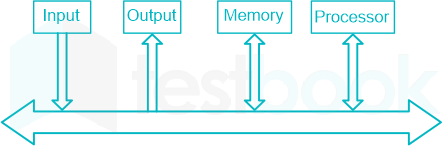
Hence the correct answer is Single BUS structure.
Additional Information
- MULTIBUS II is an open system bus architecture for designing general-purpose 8-, 16-, and 32-bit microcomputer systems.
Which of the following is a lever that can be moved in several directions to control the movement of an image on a computer monitor or similar display screen ?
Answer (Detailed Solution Below)
Computer Graphics Question 9 Detailed Solution
Download Solution PDFThe Correct Answer is Joystick.
Key Points
- Joy Stick is a pointing device used to move an object on a screen in any direction.
- It employs a vertical rod mounted on a base with one or two buttons.
- Joysticks are often used to control video games, and usually have one or more push-buttons whose state can also be read by the computer.
Additional Information
- Optical Mark Reading (OMR)
- Optical Mark Reading (OMR) is a method of entering data into a computer system.
- Optical Mark Readers reads pencil or pen marks made in pre-defined positions on paper forms as responses to questions or tick list prompts.
- Visual Display Unit
- Visual Display Unit is a device for displaying input signals as characters on a screen.
- The monitor is an example of VDU.
- MIDI (Musical Instrument Digital Interface) controller
- It is a way to connect devices that make and control sounds — such as synthesizers, samplers, and computers — so that they can communicate with each other.
Which of the following device is a hard copy device?
Answer (Detailed Solution Below)
Computer Graphics Question 10 Detailed Solution
Download Solution PDFThe correct answer is Bubblejet Printer and Laser Printer.
Key Points
- Bubblejet Printer and Laser Printer:
- Hardcopy output devices are devices that provide output on printed paper in a human readable format.
- Both printers are hard copy output devices because they provide output on printed paper.
Additional Information
- LCD Monitor and LCD Projector:
- They are not hard copy output devices because they do not provide output on printed paper.
- Daisy Wheel Printer and LED Monitor:
- Daisy Wheel printers are hard copy devices, but LED monitors are not hard copy devices.
- Inkjet Printers and LCD Monitors:
- Inkjet printers are hard copy devices, but LCD monitors are not hard copy devices.
Which is NOT an input device?
Answer (Detailed Solution Below)
Computer Graphics Question 11 Detailed Solution
Download Solution PDFExplanation:
- Some commonly used Input/Output devices are listed in the table below.
|
Input Devices |
Output Devices |
|
Keyboard |
Monitor |
|
Mouse |
LCD |
|
Joystick |
Printer |
|
Scanner |
Plotter |
|
Light Pen |
|
|
Touch Screen |
|
Input device:
- An input device is a piece of hardware used to provide data to a computer used for interaction and control. It allows the input of raw data to the computer for processing.
- Some of the input devices are
- Keyboard: Keyboard is one of the primary input devices used to input data and commands. It has function keys, control keys, arrow keys, a keypad, and the keyboard itself with the letters, numbers, and commands.
- Mouse: It is an input device used to control the cursor and coordinates. It can be wired or wireless.
- Microphone: It is an input device that allows users to input audio into their computers.
- Scanner: It is an input device that reads an image and converts it into a digital file. A scanner is connected to a computer through a USB.
- Touchscreen: It is an input device that allows users to interact with a computer using their fingers. It is used widely in laptop monitors, smartphones, tablets, cash registers, and information kiosks.
- Plotter: The plotter is the computer's output device that could print graphics as well as accommodate full-size engineering and architectural drawings. Using multiple colored pens, plotters were also able to print in color long before inkjet printers became an alternative.
Which of the following options is a common function of an input device?
Answer (Detailed Solution Below)
Computer Graphics Question 12 Detailed Solution
Download Solution PDFThe correct answer is read input data.
Key Points
- Read Input Data:
- The main function of an input device is to read or capture data from the user and send it to the computer for processing.
- Examples: Keyboard reads keystrokes, scanner reads images, and microphone reads audio signals.
Additional Information
- Compile Input Data:
- Compilation is the process of converting source code into machine code, which is done by a compiler (software), not by input devices.
- Processing Input Data:
- Processing is performed by the CPU, not input devices. Input devices only send raw data to the CPU.
- Link Input Data:
- This is not a function of input devices. Input devices do not link data; they only provide data to the system.
Which among the below set of colours are generally known as the primary colours of light?
Answer (Detailed Solution Below)
Computer Graphics Question 13 Detailed Solution
Download Solution PDFThe correct answer is Red, Green, Blue.
- Red, green, and blue are the primary colours of light—they can be combined in different proportions to make all other colors.
- There are two colour models:
- Light Color Primaries (Red, Green, Blue).
- Pigment Color Primaries (Cyan, Magenta, Yellow).
 Important Points
- Primary colours make all other colours:
- Red + Green = Yellow.
- Green + Blue = Cyan.
- Blue + Red = Magenta.
- There are three Secondary Colors (S'): Orange, Green, Violet.
- There are six Tertiary Colors (Ts): Red-Orange, Yellow-Orange, Yellow-Green, Blue-Green, Blue-Violet, Red-Violet.
- Tertiary is formed by mixing a primary with a secondary.
Additional Information
- In terms of wavelengths, visible light ranges from about 400 nm to 700 nm.
- light with a wavelength of about 400 nm is seen as violet, and light with a wavelength of about 700 nm is seen as red.
Key Points
- The inner surfaces of human eyes contain photoreceptors—specialized cells that are sensitive to light and relay messages to the brain.
- There are two types of photoreceptors: cones (which are sensitive to colour) and rods (which are more sensitive to intensity).
- Humans are able to see an object when light from the object and enters their eyes and strikes these photoreceptors.
Which of the following is an example of an input device?
Answer (Detailed Solution Below)
Computer Graphics Question 14 Detailed Solution
Download Solution PDFThe correct answer is Barcode Reader.
Key Points
- Barcode Reader:
- This is an example of an input device used to read information contained in barcodes.
Additional Information
- Speaker:
- This is an example of an output device.
- It produces sound through a vibrating transducer called a driver.
- DLP Projector:
- It stands for Digital Light Processing Projector.
- This is an example of an output device.
- Bubblejet Printer:
- A Bubblejet printer is an example of an output device that is used to print information on paper.
Drawing, photographs, movies and simulation comes under the category of :
Answer (Detailed Solution Below)
Computer Graphics Question 15 Detailed Solution
Download Solution PDFKey Points
- In order to transmit ideas, graphic design is a creative process that mixes art and technology.
- The art of computer graphics involves using a computer to create images. Computer graphics ultimately produce a picture, which could be an engineering design, business graph, or other visual media.
Additional Information
- Animation refers to a style of filmmaking in which the images are rapidly displayed in succession to create the illusion of movement.
- Images refer to a visual representation of something, such as a picture or photograph.
- Graphics refers to the use of computer technology to create visual images, designs, and illustrations.
- The text refers to written or printed words, as opposed to images or graphics.
