
Chemistry MCQ Quiz - Objective Question with Answer for Chemistry - Download Free PDF
Last updated on Jun 3, 2026
Latest Chemistry MCQ Objective Questions
Chemistry Question 1:
Match List I with List II regarding Chemical Weathering processes:List-I (Process) List-II (Description) a. Solution I. Reaction of carbonate and bicarbonate with minerals b. Carbonation II. Chemical addition of water into minerals causing expansion c. Hydration III. Minerals dissolve in water or acids and get removed d. Oxidation IV. Combination of a mineral with oxygen to form oxides or hydroxides
Choose the correct answer from the options given below:
Answer (Detailed Solution Below)


Chemistry Question 1 Detailed Solution
 Key Points
- Solution: This process involves the removal of solids in solution and depends upon the solubility of a mineral in water or weak acids. In this process, minerals dissolve in water or acids and get removed from the rock structure. This is particularly common with highly soluble minerals like nitrates, chlorides, and sulphates. Hence, match a-III is correct.
- Carbonation: This is the reaction of carbonate and bicarbonate with minerals. Carbon dioxide from the atmosphere and soil air is absorbed by water to form carbonic acid, which acts as a weak acid. This acid reacts with minerals like limestone (calcium carbonate) to form calcium bicarbonate, which is soluble in water. Hence, match b-I is correct.
- Hydration: This process involves the chemical addition of water into minerals. Minerals take up water and expand, leading to an increase in the volume of the material or rock. For example, calcium sulphate absorbs water to become gypsum, which is more unstable and prone to further weathering. Hence, match c-II is correct.
- Oxidation: This refers to the combination of a mineral with oxygen to form oxides or hydroxides. It occurs where there is ready access to the atmosphere and oxygenated waters. In rocks, this is most commonly seen in iron-rich minerals, where ferrous iron is converted to ferric iron (rusting), resulting in a change of color to red or yellow. Hence, match d-IV is correct.
- Chemical Weathering overall leads to the decomposition and alteration of the internal structure of minerals through chemical reactions, typically involving water and atmospheric gases. Hence, the correct answer is a-III, b-I, c-II, d-IV.
 Additional Information
- Reduction: This is the reverse of oxidation and occurs when oxidized minerals are placed in an environment where oxygen is absent. Such conditions are usually found below the water table or in waterlogged soils, where the red color of iron oxides may turn to greenish or greyish hues.
- Hydrolysis: This is a chemical weathering process where H+ or OH- ions of water react with ions of a mineral. It is a major process in the weathering of silicate minerals like feldspar, leading to the formation of clay minerals.
- Role of Climate: The rate of chemical weathering is highly dependent on temperature and moisture. It is most active and rapid in hot and humid tropical climates, whereas it is very slow in dry and cold climates.
- Biological Weathering: While the question focuses on chemical processes, biological weathering also plays a role. It involves the removal of minerals by organisms like bacteria, lichens, and mosses, which produce organic acids that accelerate the chemical breakdown of rocks.
- Weathering Products: The end products of chemical weathering often include clay minerals, soluble salts, and iron oxides, which contribute significantly to soil formation and the pedogenic process.
 Important Points
- The process of carbonation is the primary driver behind the formation of Karst topography, creating features like stalactites, stalagmites, and caves.
- In oxidation, the transition of iron from a reduced state (Fe2+) to an oxidized state (Fe3+) is what causes the characteristic reddish-brown staining on weathered rock surfaces.
- Hydration is reversible; if the mineral loses the chemically bound water through dehydration, it may return to its original form, though the physical integrity of the rock is usually compromised by the initial expansion.


Chemistry Question 2:
Which of the following layers of the Earth's interior is primarily composed of nickel and iron in a solid state?
Answer (Detailed Solution Below)
Chemistry Question 2 Detailed Solution
The correct answer is Inner Core.
Key Points
- The Inner Core is the Earth's innermost part and is a primarily solid ball with a radius of about 1,220 kilometers.
- It is composed mainly of an iron-nickel alloy, often referred to as Nife (Ni for Nickel and Fe for Ferrum/Iron). Hence, the statement regarding its composition is correct.
- The Inner Core remains in a solid state despite the extremely high temperatures, which are estimated to be around 5,400 °C (similar to the surface of the Sun). This is due to the intense pressure at the center of the Earth, which prevents the atoms from moving into a liquid state.
- It was discovered by Danish seismologist Inge Lehmann in 1936 by analyzing seismograms from earthquakes.
- The density of the Inner Core is very high, ranging between 12.6 g/cm3 and 13.0 g/cm3, reflecting the presence of heavy metals.
Additional Information
- Outer Core:
- This layer lies between the mantle and the inner core, extending from a depth of 2,900 km to 5,150 km.
- Unlike the inner core, the Outer Core is in a liquid state. The convection currents of molten iron and nickel in this layer generate the Earth's magnetic field via the dynamo effect.
- Lower Mantle:
- The Lower Mantle extends from 660 km to 2,900 km below the Earth's surface.
- It is composed primarily of magnesium and iron-bearing silicates. While it is solid, it behaves as a plastic/viscous material over long geological time scales.
- Upper Crust:
- The Crust is the outermost thin shell of the Earth. The Upper Crust (Continental Crust) is mainly composed of silica (Si) and aluminum (Al), commonly known as the Sial layer.
- It has a lower density compared to the core and mantle, averaging about 2.7 g/cm3 to 3.0 g/cm3.
Important Points
- Seismic Discontinuities:
- Lehmann Discontinuity: The boundary separating the liquid Outer Core and the solid Inner Core.
- Gutenberg Discontinuity: The boundary between the Lower Mantle and the Outer Core.
- Mohorovicic (Moho) Discontinuity: The boundary between the Crust and the Mantle.
- Temperature and Pressure: As we move from the Crust toward the Inner Core, both temperature and pressure increase significantly. The pressure at the center of the Earth is estimated to be over 3.6 million atmospheres.
- Seismic Waves: P-waves (Primary waves) can travel through both solid and liquid layers, but they refract at boundaries. S-waves (Secondary waves) cannot travel through liquids, which is how scientists confirmed the Outer Core is liquid.
Chemistry Question 3:
Reactions involving exchange of ions between reactants are called as:
Answer (Detailed Solution Below)
Chemistry Question 3 Detailed Solution
The correct answer is Double displacement reactions.
Key Points
- Double displacement reactions are chemical reactions in which the positive and negative ions of two ionic compounds exchange places to form two entirely new compounds.
- The general representation for this type of reaction is AB + CD → AD + CB, where A and C are cations and B and D are anions.
- These reactions typically occur in aqueous solutions where the ions are free to move and interact with each other.
- One of the most common features of a double displacement reaction is the formation of a precipitate, which is an insoluble solid that separates from the solution.
- An example is the reaction between sodium sulfate (Na2SO4) and barium chloride (BaCl2), which produces a white precipitate of barium sulfate (BaSO4) and sodium chloride (NaCl).
Additional Information
- Oxidation and Reduction Reactions:
- Oxidation is defined as the gain of oxygen, the loss of hydrogen, or the loss of electrons by a substance during a reaction.
- Reduction is the loss of oxygen, the gain of hydrogen, or the gain of electrons.
- When both oxidation and reduction happen simultaneously in a single reaction, it is termed a Redox reaction.
- Combination Reactions:
- A combination reaction (or synthesis reaction) occurs when two or more reactants combine to form a single product.
- A classic example is the burning of magnesium ribbon in oxygen to form magnesium oxide (MgO).
- Decomposition Reactions:
- In a decomposition reaction, a single compound breaks down into two or more simpler substances.
- This process often requires an input of energy in the form of heat, light, or electricity.
- Neutralization Reaction:
- This is a specific type of double displacement reaction that occurs between an acid and a base to produce salt and water.
- For example, Hydrochloric acid (HCl) reacts with Sodium hydroxide (NaOH) to form Sodium chloride (NaCl) and Water (H2O).
- Single Displacement Reaction:
- Unlike double displacement, in a single displacement reaction, a more reactive element displaces a less reactive element from its compound.
- Example: Zinc (Zn) reacting with Copper sulfate (CuSO4) to form Zinc sulfate (ZnSO4) and Copper (Cu) metal.
Chemistry Question 4:
What is the percentage of carbon in earth’s crust?
Answer (Detailed Solution Below)
Chemistry Question 4 Detailed Solution
The correct answer is 0.02%.
Key Points
- Carbon is present in the Earth's crust in a very small amount, which is approximately 0.02%. This percentage represents carbon found in various chemical combinations within the terrestrial layers.
- In the Earth's crust, carbon is primarily found in the form of minerals such as carbonates (like limestone, chalk, and marble), hydrogen carbonates, and fossil fuels.
- Common fossil fuels that store carbon in the crust include coal, petroleum, and natural gas, which are formed from the remains of ancient organic matter over millions of years.
- In the atmosphere, the amount of carbon is also relatively low, existing as carbon dioxide (CO2) at approximately 0.03% to 0.04%.
- Despite its low abundance (0.02%), carbon is the central element for all known life, as it has the unique ability to form stable bonds with many elements, allowing the existence of complex organic molecules.
Additional Information
- Abundance of Other Elements: The Earth's crust is dominated by Oxygen (approximately 46.6%) and Silicon (27.7%). Other major elements include Aluminum (8.1%), Iron (5.0%), Calcium (3.6%), Sodium (2.8%), and Potassium (2.6%).
- Catenation Power: Carbon possesses a unique property called catenation, which is the ability to form long chains or rings by bonding with other carbon atoms. This is why there are millions of carbon-based compounds known today.
- Allotropes of Carbon: Carbon exists in the crust in several allotropic forms such as diamond (the hardest natural substance), graphite (used as a lubricant and in pencils), and fullerenes.
- Carbonate Rocks: A significant portion of crustal carbon is locked in sedimentary rocks. For instance, calcium carbonate (CaCO3) makes up vast mountain ranges and oceanic floors in the form of limestone.
- Biological Importance: Every living cell is made of proteins, carbohydrates, fats, and nucleic acids (DNA/RNA), all of which are carbon-containing compounds.
Important Points
- Carbon Cycle: The 0.02% of carbon in the crust is not static; it moves through the geosphere, hydrosphere, and atmosphere via the Carbon Cycle, which helps regulate the Earth's temperature.
- Industrial Applications: Beyond its role in nature, carbon is essential in the metallurgy industry, particularly as coke for the reduction of iron ore in blast furnaces to produce steel.
- Isotopes: Naturally occurring carbon contains three isotopes: Carbon-12, Carbon-13, and the radioactive Carbon-14, the latter of which is used in radiocarbon dating to determine the age of ancient organic artifacts.
Chemistry Question 5:
Which of the following solutions is the most concentrated?
Answer (Detailed Solution Below)
Chemistry Question 5 Detailed Solution
The correct answer is 10 g of salt in 50 mL of water.
Key Points
- Concentration is a measure of the amount of solute that has been dissolved in a given amount of solvent or solution. In these options, salt is the solute and water is the solvent.
- To determine which solution is the most concentrated, we calculate the mass-by-volume ratio (Mass of solute / Volume of solvent) for each option:
- Option 1: 5 g of salt in 100 mL of water = 5/100 = 0.05 g/mL.
- Option 2: 10 g of salt in 50 mL of water = 10/50 = 0.2 g/mL. Hence, this option is the most concentrated.
- Option 3: 10 g of salt in 100 mL of water = 10/100 = 0.1 g/mL.
- Option 4: 20 g of salt in 200 mL of water = 20/200 = 0.1 g/mL.
- The solution in Option 2 has the highest value (0.2 g/mL), meaning it has the largest amount of salt per unit volume of water.
- A solution is considered concentrated when it contains a large amount of solute relative to the solvent, whereas it is dilute when it contains a small amount of solute.
- The concentration can be increased by either adding more solute or by reducing the amount of solvent (e.g., through evaporation).
Additional Information
- Solute, Solvent, and Solution:
- A Solute is the substance being dissolved (usually present in smaller amounts, like salt or sugar).
- A Solvent is the substance doing the dissolving (usually present in larger amounts, like water).
- A Solution is a homogeneous mixture of two or more substances.
- Saturated Solution: This is a solution in which no more solute can be dissolved at a specific temperature. If more salt is added to a saturated salt solution, it will simply settle at the bottom.
- Methods of Expressing Concentration:
- Mass Percentage: (Mass of solute / Mass of solution) × 100.
- Volume Percentage: (Volume of solute / Volume of solution) × 100.
- Molarity (M): The number of moles of solute dissolved in 1 liter of solution. It is the most common unit used in chemical laboratories.
- Effect of Temperature: Generally, the solubility of solid solutes like salt in liquid solvents like water increases with an increase in temperature. This allows a solution to become supersaturated.
- Dilution Formula: When more solvent is added to a solution, its concentration decreases. This is often calculated using the formula M1V1 = M2V2, where M is molarity and V is volume.
Important Points
- Universal Solvent: Water is often called the universal solvent because it dissolves more substances than any other liquid due to its polar nature.
- Homogeneity: In a true solution, the solute particles are so small (less than 1 nanometer) that they cannot be seen with the naked eye and do not scatter a beam of light (Tyndall effect).
- Stability: Solutions are stable; the solute particles do not settle down when left undisturbed, unlike in a suspension.
Top Chemistry MCQ Objective Questions
Non-metals are generally bad conductors of electricity. However, graphite is a good conductor of electricity because it
Answer (Detailed Solution Below)
Chemistry Question 6 Detailed Solution
Download Solution PDFThe correct answer has free electrons.
Key Points
- Graphite:
- Graphite is a form of carbon that has a hexagonal lattice structure.
- It is made up of layers of carbon atoms that are bonded together in an sp2 hybridization.
- The layers are held together by weak Van der Waals forces, which allow them to slide over each other easily.
- Graphite is a good conductor of electricity and has a high melting point.
- It is used in applications such as electrodes, lubricants, and pencils.
- Graphite can conduct electricity because of the delocalized (free) electrons in its structure.
- These arise because each carbon atom is only bonded to 3 other carbon atoms.
Additional Information
- The property of an element that exists in more than one physical form is called allotropy and the forms are termed allotropes
- Carbon shows allotropy due to catenation, which is the linking of atoms of the same element with one another to form long chains.
- There are various allotropes of carbon that exist in nature including diamond, graphene, and fullerenes.
Chemical name of washing soda is:
Answer (Detailed Solution Below)
Chemistry Question 7 Detailed Solution
Download Solution PDFThe correct answer is Sodium carbonate.
Explanation:
- Washing soda is a chemical compound with the formula Na2CO3, known as sodium carbonate, and it's a salt of carbonic acid.
- Properties of a Washing soda:
- It is a transparent crystalline solid.
- It is one of the few metal carbonates which are soluble in water.
- It is alkaline with a pH level of 11, it turns red litmus to blue.
- It has detergent properties or cleansing properties because it can remove dirt and grease from dirty clothes, etc.
- It attacks dirt and grease to form water-soluble products, which are then washed away on rinsing with water.
Important Points
Some common chemical compounds with their common names are:
|
Chemical Compounds |
Common Names |
Chemical Formulas |
|
Sodium Bicarbonate |
Baking Soda |
NaHCO3 |
|
Calcium ChlorohypoChlorite |
Bleaching Powder |
CaOCl2 |
|
Sodium Hydroxide |
Caustic Soda |
NaOH |
|
Sodium Carbonate |
Washing Soda |
Na2CO3 .10 H2O |
|
Carbon Dioxide |
Dry Ice |
CO2 |
|
Copper Sulphate |
Blue Vitriol |
CuSO4 |
|
Ferrous Sulphate |
Green Vitriol |
FeSO4 |
|
Sulphuric Acid |
Oil of vitriol |
H2SO4 |
|
Calcium Sulphate Hemihydrate |
Plaster of Paris |
(CaSO4. 1/2H2O) |
|
Calcium Sulphate Dihydrate |
Gypsum |
CaSO4.2H2O |
|
Calcium Hydroxide |
Slaked Lime |
Ca(OH)2 |
|
Chile Saltpeter |
Sodium nitrate |
NaNO3 |
|
Saltpetre |
Potassium nitrate |
KNO3 |
|
Muriatic acid |
Hydrochloric acid |
HCl |
When 1 litre of water is cooled from 4°C to 0°C, its volume _____.
Answer (Detailed Solution Below)
Chemistry Question 8 Detailed Solution
Download Solution PDFThe correct answer is increases.
Important Points
- In normal cases, the volume of substances increases on heating and decreases while cooling.
- When 1 litre of water is cooled from 4°C to 0°C volume of water will start increasing this due to water's unique property known as 'Anomalous Expansion of Water'.
- Anomalous Expansion of Water occurs between 4°C to 0°C.
- The density of water is a maximum at 4 °C.
- When water is cooled from 4°C to 0°C, its density decreases.
- The anomalous expansion of water helps preserve aquatic life during very cold weather.
Explanation:
- When water reaches 4°C the molecules have been pushed as close to one another as possible and the density of water becomes precisely 1.00 g/cm³
- When water freezes at 0°C due to the crystal structure the molecules arranged in some structured fashion so a little far apart ended up less dense - 0.93 g/cm3 - and so floats due to buoyancy.
As density decreases the volume increases.
Volume = mass /density.
Which of the following is called 'Pearl ash'?
Answer (Detailed Solution Below)
Chemistry Question 9 Detailed Solution
Download Solution PDFK2CO3 or potassium carbonate is known as pearl ash.
- Pearl ash, in ancient times, was created by baking potash in a kiln in order to remove impurities. The remaining fine, white powder was pearl ash.
- Potassium carbonate is an inorganic compound and a white salt which is soluble in water.
- It is mainly used in the production of glass and soap.
Additional Information
Which of the following processes is known as fusion?
Answer (Detailed Solution Below)
Chemistry Question 10 Detailed Solution
Download Solution PDFThe correct answer is to Change of solid to liquid.
Concept:
- A matter can exist in three basic forms of state.
- The states of matter are namely, solid, liquid, and gas.
- The states of matter are interconvertible with gain or loss of energy.
Explanation:
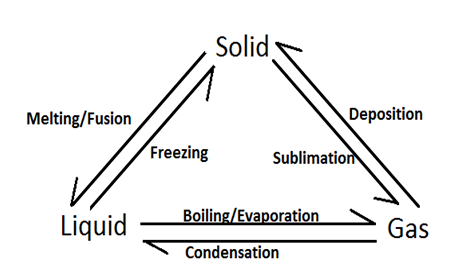
| Conversion | Name |
| Solid → Liquid | Fusion or Melting |
| Liquid → Solid | Solidification |
| Liquid → Gas | Evaporation |
| Gas → Liquid | Condensation |
| Solid → Gas / Gas → Solid | Sublimation/ Deposition |
Additional Information
| Conversion | Temperature of conversion |
| Solid → Liquid | Melting point |
| Liquid → Solid | Freezing point |
| Liquid → Gas | Boiling point |
| Gas → Liquid | Condensation point |
| Solid → Gas / Gas → Solid | Sublimation point |
CO2 when passed in excess, in lime water turns colourless again because of:
Answer (Detailed Solution Below)
Chemistry Question 11 Detailed Solution
Download Solution PDFExplanation:
- Calcium hydroxide is sparingly soluble in water producing an alkaline solution known as limewater.
- Calcium Carbonate is a chemical compound found commonly in rocks as minerals and is the main component of pearls and the shells of marine organisms, eggs, etc.
- When carbon dioxide gas is passed through or over limewater, it turns milky due to the formation of calcium carbonate.
- In the chemical reaction it can be shown as :
\(\rm \underset{Lime\ water}{Ca (OH)_2} \ (aq) \ + \ \underset{Carbon \ Dioxide}{CO_2 \ (g) }\ \longrightarrow \ \underset{Calcium \ Carbonate}{CaCO_3 \ (g)}\)
- However, when an excess of CO2 is passed through this solution, the milkiness disappears. This is due to the formation of calcium bicarbonate which is colorless and soluble in water.
Additional Information Reaction involved-
CaCO3 + 2HCl → CaCl2 + CO2 + H2O
- The evolved gas is carbon dioxide which then passes through lime water and turns it milky.
Ca(OH)2 + CO2 → H2O + CaCO3
- Due to formation of these compounds
- when excess CO2 is passed
CaCO3 + H2O + CO2 → Ca(HCO3)2
- Bicarbonate is formed which again clears the solution
 Mistake Points
- Do not confuse Calcium carbonate and calcium bicarbonate.
- One produces white colour while the other makes it colourless.
Who coined the word ‘atom’?
Answer (Detailed Solution Below)
Chemistry Question 12 Detailed Solution
Download Solution PDF- The word ‘atom’ is coined by Democritus.
- He suggested that if we go on dividing matter at a certain point the atom becomes indivisible or cannot be divided further.
- He called these particles as atoms (Indivisible).
|
Scientist |
Discovered |
|
Thomson |
Electron |
|
E Rutherford |
Discovered alpha and beta particles |
|
John Dalton |
Father of Atomic Theory |
Which of the following acid is found in Nettle plant?
Answer (Detailed Solution Below)
Chemistry Question 13 Detailed Solution
Download Solution PDFThe correct answer is Methanoic acid.
Key Points
- Nettle is an herbaceous plant that grows in the wild.
- Nettle leaves have stinging hair, which causes painful stings when touched accidentally.
- This is due to the methanoic acid secreted by them.
- A traditional remedy is rubbing the area with the leaf of the dock plant, which often grows beside the nettle.
Additional Information
|
Natural source |
Acid present |
|
Vinegar |
Acetic Acid |
|
Orange |
Citric acid |
|
Tamarind |
Tartaric acid |
|
Tomato |
Oxalic acid |
|
Curd |
Lactic acid |
|
Lemon |
Citric acid |
|
Nettle plant |
Methanoic acid |
The elements in the first group of s-block are also known as ________ .
Answer (Detailed Solution Below)
Chemistry Question 14 Detailed Solution
Download Solution PDFThe correct answer is option 1, i.e Alkali Metals.
EXPLANATION:
- The elements in the first group of s-block are also known as Alkali Metals. These have only one electron in their outermost shell and hence are quite reactive as they easily lose their electron to form bonds with non-metals.

- The elements in the second group of s-block are also known as Alkaline Earth Metals. These have two electrons in their outermost shell and are less reactive than Alkali metals.
- Halogens are the group 17 elements and are placed in the p-block.
- Noble gases are the group 18 elements and are placed in the p-block. These are the least reactive amongst all the elements found in the periodic table as they have a stable configuration.
_Sunny (Type)_Madhu(Dia)_D1_utkarsha.PNG)
Which of the following is NOT the correct match?
Answer (Detailed Solution Below)
Chemistry Question 15 Detailed Solution
Download Solution PDFThe correct answer is The acid present in tomatoes.
Key Points
- Oxalic acid is a chemical compound that occurs naturally in almost every plant to some degree, including fruit, vegetable and grain plants.
- Tomato contains more than 10 types of acids such as citric acid, malic acid, ascorbic acid, oxalic acid etc.
- The oxalic acid content of tomatoes is about 50 mg per 100 g serving.
Additional Information
- Some natural sources of acid:
| Natural Source | Acid |
| Vinegar | Acetic acid |
| Orange | Citric acid |
| Tamarind /Grapes | Tartaric acid |
| Sour milk (Curd) | Lactic acid |
| Lemon | Citric acid |
| Ant sting | Formic acid |
| Rancid Butter | Butyric acid |
| Nettle sting | Methanoic acid |
